You’ve found a ₹1 crore flat. A similar one in the same society rents for ₹25,000 a month. Your parents say rent is money thrown away. A friend says buying is the worst investment you’ll make.
Both can be right. Which one is right for you depends on a few numbers you can work out. This guide goes through them, using the same model as the Rent vs Buy calculator in EMI Loan Calculator: SIP & Tax.
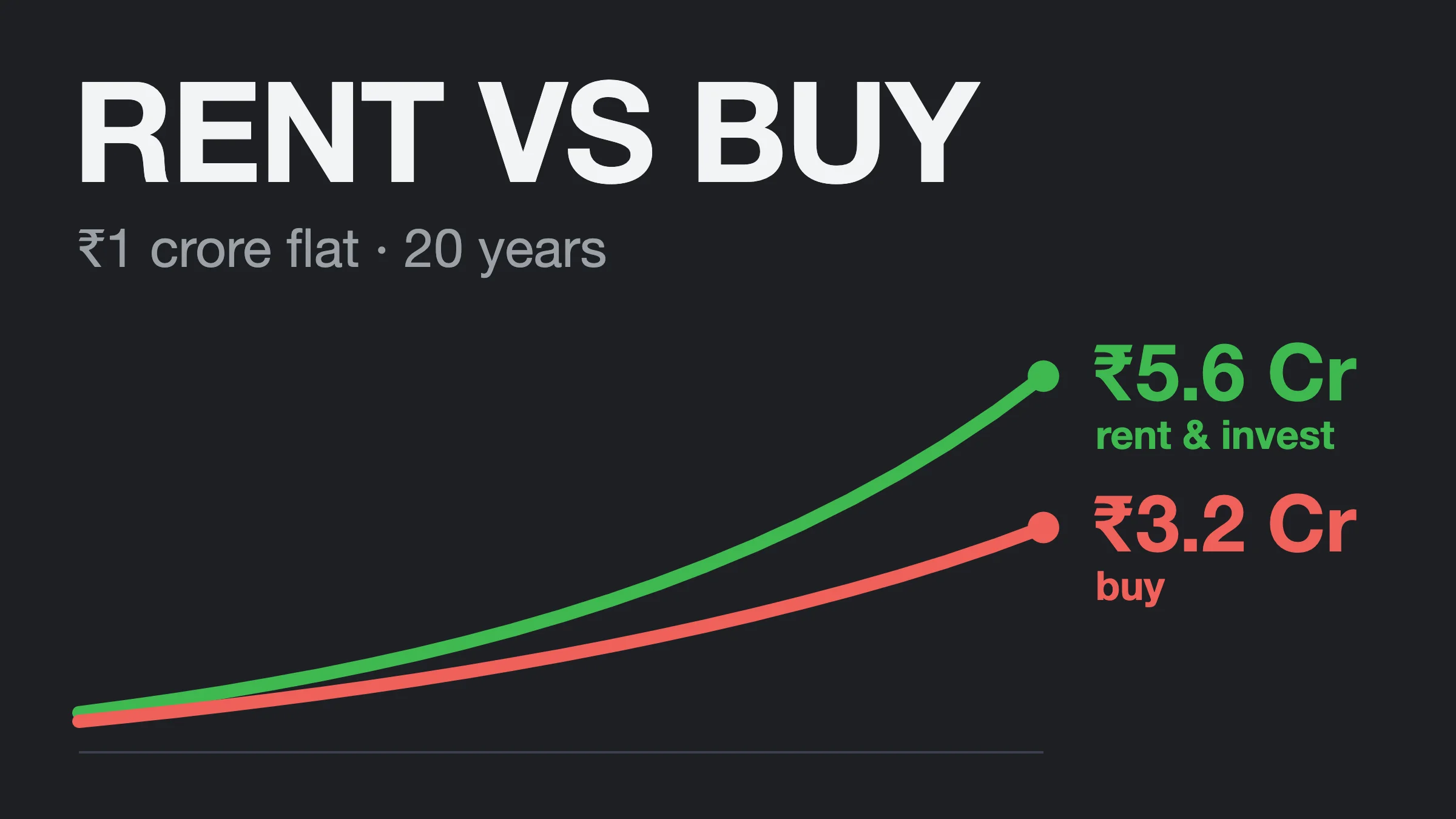
The short answer: for this flat, renting and investing the difference leaves you about ₹2.37 crore richer after 20 years. Buying wins only if flat prices grow faster than 9% a year, or if a similar flat rents for more than ₹42,700 a month today.
A ₹1 crore flat costs more than ₹1 crore
Start with the cash you need on the day you get the keys. With a 20% down payment and an ₹80 lakh loan:
| Cost | Amount |
|---|---|
| Down payment (20%) | ₹20,00,000 |
| Stamp duty + registration (~7%, varies by state) | ₹7,00,000 |
| Brokerage (1%) | ₹1,00,000 |
| Loan processing fee (0.5% of the loan) | ₹40,000 |
| Legal and documentation | ₹20,000 |
| Interiors and furnishing | ₹5,00,000 |
| Cash needed up front | ₹33,60,000 |
₹13.6 lakh of that is not the house. It’s fees, tax and furniture, and you won’t get it back when you sell. This is why a buyer’s net worth falls in the first year, even though the flat has gone up in value.
Then the monthly bill. At 8.5% for 20 years the EMI is ₹69,426. In the first year, about 81% of each EMI is interest. Over the full loan you pay the bank ₹86.6 lakh in interest, more than the loan itself. On top of the EMI there’s society maintenance, property tax and repairs, and all of them go up every year.
The only fair comparison: same money, same spending
Most rent vs buy comparisons go wrong in one of two ways. Either they count only the rent and forget that the renter still has ₹33.6 lakh to invest, or they count the renter’s investments as profit without subtracting the money the renter put in.
A fair comparison gives both people the same starting cash and the same monthly budget:
- Day one. Both start with ₹33.6 lakh. The buyer spends it on the flat. The renter pays a two-month deposit and one month’s brokerage, then invests the rest.
- Every month. The buyer pays EMI + maintenance (plus property tax and repairs once a year). The renter pays rent. Whoever spent less that month invests the difference. Early on that’s the renter. Rent rises about 7% a year, though, and at some point it passes the buyer’s EMI. From then on the buyer invests the gap. Many calculators skip this step and the buyer’s savings simply disappear.
- At the end. The buyer has the flat, minus any loan left, plus their investments. The renter has their investments plus the deposit back.
Both sides earn the same return on what they invest. Nobody gets extra money or a bigger budget.
Every number in this guide comes from that month-by-month simulation, 240 months for 20 years. With its additions turned off (the buyer investing the gap, the deposit and tax), the model matches Zero1’s “EMI vs SIP” spreadsheet to the rupee, so the basic mechanics are checked against an independent calculation.
What happens to the ₹1 crore flat
Defaults: flat price growing at 6% a year, rent at 7%, investments at 11% (a long-run Nifty index fund after costs), new tax regime.
| After | Net worth if you buy | Net worth if you rent and invest |
|---|---|---|
| 1 year | ₹27.6 L | ₹43.2 L |
| 5 years | ₹63.3 L | ₹92.7 L |
| 10 years | ₹1.23 Cr | ₹1.85 Cr |
| 20 years | ₹3.24 Cr | ₹5.61 Cr |
After 20 years, renting and investing leaves you about ₹2.37 crore richer. The flat grows to ₹3.2 crore and the loan is paid off, but the renter’s fund compounds for 20 years from a ₹33 lakh head start.
The main reason is the price-to-rent ratio. The flat costs 33 times a year’s rent, so rent is only 3% of the price, while the loan costs 8.5%. Paying 3% of a flat’s value to live in it is cheaper than paying 8.5% interest to own it.
The two numbers that decide it for you
The ₹2.37 crore depends on what you assume about house prices and the market, and nobody knows those for the next 20 years. So the calculator works backwards and finds the tie points: the values at which buying and renting end level.
For this flat, buying wins only if:
- flat prices grow faster than 9.0% a year for 20 years, or
- rent for a similar flat is above ₹42,700 a month today.
This is easier to judge than a forecast. Ask yourself whether this locality will beat 9% a year for two decades. Look up what similar flats actually rent for. Here’s how the gap narrows as rent rises:
| Rent today | Renter ahead after 20 years |
|---|---|
| ₹25,000 | ₹2.37 Cr |
| ₹30,000 | ₹1.70 Cr |
| ₹35,000 | ₹1.03 Cr |
| ₹40,000 | ₹36 L |
| ₹45,000 | buyer ahead by ₹31 L |
When buying wins
Buying makes sense when rent is high compared with the price. Take a ₹1.5 crore flat that rents for ₹55,000 a month, a 4.4% rental yield, which happens in some parts of big metros. With prices growing at 7%:
- buying ends ₹30 lakh ahead after 20 years, and
- the buyer catches up with the renter in year 12.
Before then the renter is ahead, so the answer also depends on how long you’ll stay. Selling a flat after 5 or 7 years means paying stamp duty, brokerage and interiors for a short stay. For the ₹1 crore flat, a 7-year stay leaves the renter ₹40 lakh ahead.
The part that depends on you
Renting only wins if the renter actually invests the difference, every month, for 20 years, and doesn’t sell when the market falls 30%. A home loan forces you to save: you can’t skip an EMI. A SIP you can stop any time.
The return matters a lot too. For the ₹1 crore flat:
| Investment return | Renter ahead after 20 years |
|---|---|
| 9% | ₹86 L |
| 10% | ₹1.56 Cr |
| 11% | ₹2.37 Cr |
| 12% | ₹3.32 Cr |
If you think you’ll spend the difference instead of investing it, the honest comparison is the flat versus nothing, and the flat wins.
Tax: old regime vs new
These are the income tax rules for FY 2026-27.
Under the new tax regime, which most salaried people now use, neither side gets a tax break. There’s no deduction for home-loan interest and no HRA exemption.
Under the old regime, the buyer can deduct up to ₹2 lakh of interest a year under section 24(b), and the principal under 80C if EPF and insurance haven’t already used up the ₹1.5 lakh limit. The renter can claim HRA. In the 30% slab, the interest deduction alone cuts the renter’s lead from ₹2.37 crore to about ₹2.0 crore. Claim the principal under 80C as well and it falls to about ₹1.71 crore, before counting the renter’s HRA. The calculator asks for your basic salary and HRA so it can count both sides.
If both sold everything
Net worth on paper isn’t cash. If both people cashed out after 20 years, the buyer pays 1% brokerage and 12.5% capital gains tax on the flat, and the renter pays 12.5% tax on equity gains above ₹1.25 lakh. For the ₹1 crore flat that leaves ₹2.94 crore for the buyer and ₹5.03 crore for the renter. Tax doesn’t change the answer here.
What the numbers leave out
Owning means no landlord, no forced moves when the owner wants the flat back, no deposit fights, and a home you can change as you like. For a family with school-going kids, that stability is worth a lot, and no spreadsheet can put a number on it.
Treat the result as the price of that stability. If buying costs you ₹30 lakh over 20 years, you may happily pay it. If it costs ₹2 crore, you should at least know that before you sign.
Try it with your numbers
In EMI Loan Calculator: SIP & Tax, open Rent vs Buy from the home screen, or tap Next step after you work out a home-loan EMI. The price, loan rate and tenure carry over.
- Enter the flat price, the rent for a similar flat, and how long you’ll stay.
- Open Assumptions to change the down payment, loan rate, stamp duty for your state, interiors, maintenance and growth rates. The app warns you if your down payment is below what banks allow at that price.
- Turn on old tax regime if you file under it.
You get the verdict, both tie points, a net-worth chart for each year, what’s driving the result, and the after-tax cash-out figures.
Get EMI Loan Calculator: SIP & Tax on Google Play
This is an illustration, not financial advice. House prices, rents and market returns vary a lot by city, locality and time period. Every assumption above can be changed in the app, so check the result with your own numbers.